Probabilistic Forecasting
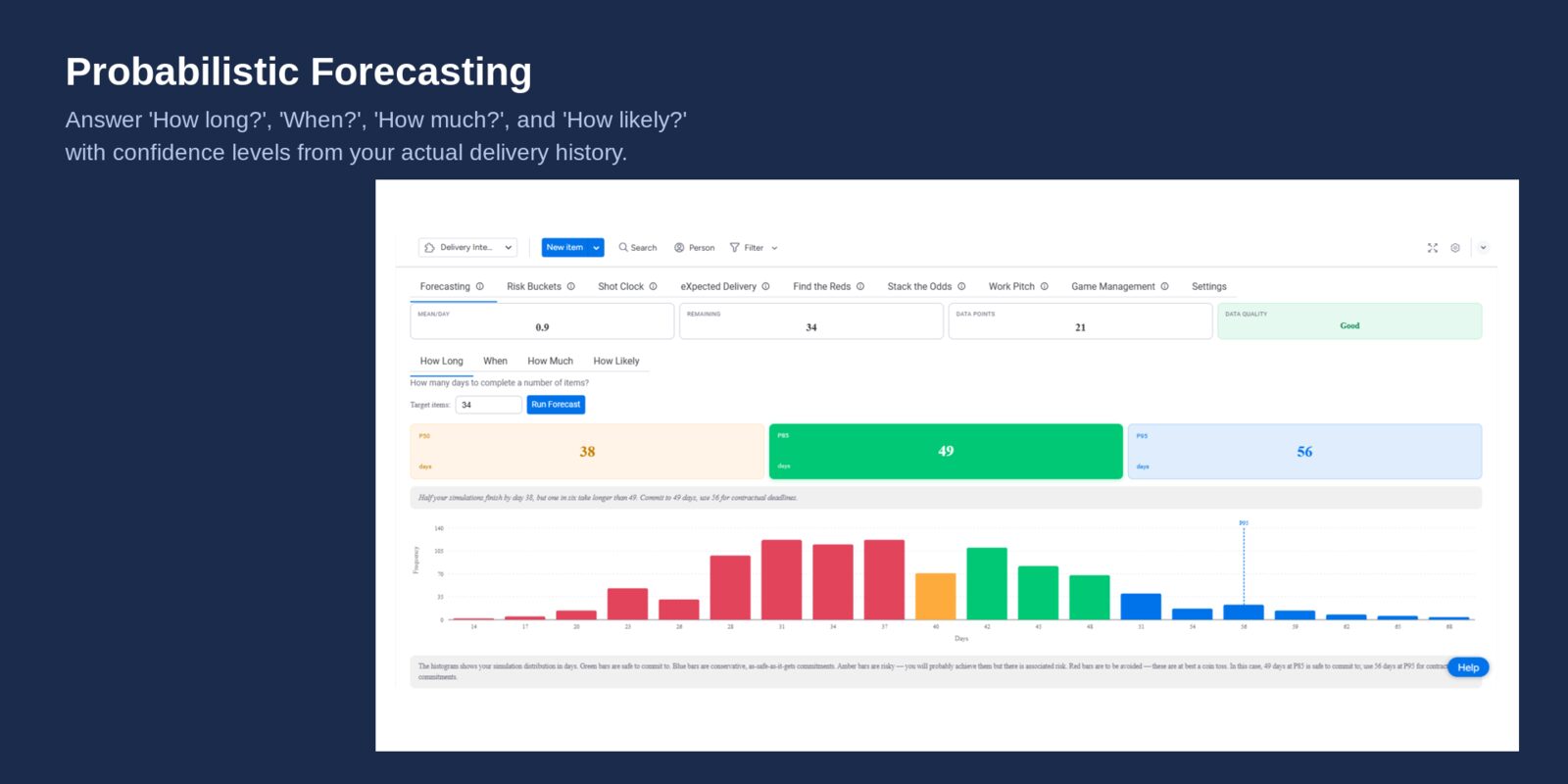
Monte Carlo simulation on your real completion history. Answer How long? When? How much? How likely? — with colour-coded percentile cards and coaching that tells you what to commit to, not just what the numbers are.
Solutions
Engineering estimates miss targets by 30–50%. Delivery Intelligence uses Monte Carlo simulation on your actual board history to answer the questions that matter: How long? When? How much? How likely? IMIRT — Irish for “sport” — brings the discipline of asking “what can we finish next?” instead of “what can we start next?” to your monday.com boards.
The software in action
Most dashboards tell you what already happened. Delivery Intelligence forecasts what's coming, classifies what's at risk, and coaches the team on where to act — all from data your board already holds.
Where it runs
The core engine — probabilistic forecasting from status-transition history — is platform-agnostic by design. It runs today as a monday.com app. Jira, Azure DevOps and GitHub are on the roadmap.
Screenful tells you what happened. IMIRT tells you what's going to happen — and what to do about it.
How it works
Engineering estimates miss targets by 30–50%. “About three weeks” hides everything that matters. Delivery Intelligence runs 1,000 simulated futures through your real throughput history — and gives you back a range, not a guess.
P50
Median outcome
Half the simulations finished by this point.
P85
Confident commitment
85% finished by this point. The commitment most teams should actually make.
P95
When failure isn't an option
Nearly all simulations finished here. Use it when it has to land.
Why this matters
Workflow zones
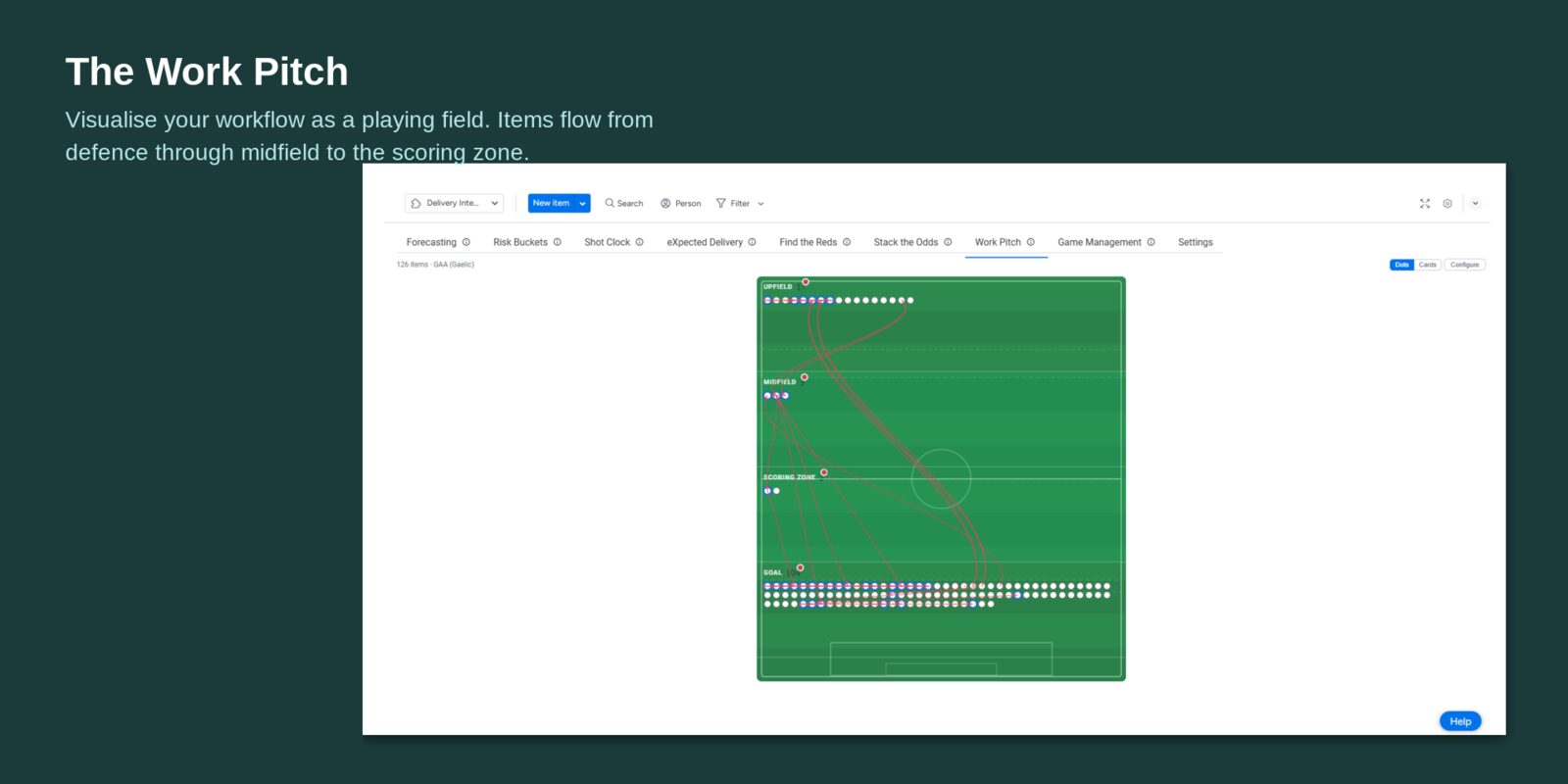
Every board's statuses get mapped to one of five workflow zones — a sports metaphor that mirrors how work actually moves through a team. Once you can see the whole pitch, you can see what's blocking, what's blocked, and what's worth finishing next.
Bench
Backlog / New
Players on the bench
Warm Up
Ready / Committed
Warming up before the game
Doing
In Progress
On the pitch, in play
Scoring Zone
Review / Testing
In the box, about to score
Goal
Done / Complete
Goal scored
Once the work is laid out across zones, dependencies become visible — and so does the cost of starting something new while an open goal sits unfinished.
No sports team gives up on an open goal by suddenly passing the ball back so they can start the next run. The same instinct applies here: if a major scoring opportunity has a dependency on something stuck in the Backlog, you're not ready to take the shot. Either remove the dependency, or get it up to the scoring zone as a priority.
What's inside
Monte Carlo simulation on your real completion history. Answer How long? When? How much? How likely? — with colour-coded percentile cards and coaching that tells you what to commit to, not just what the numbers are.
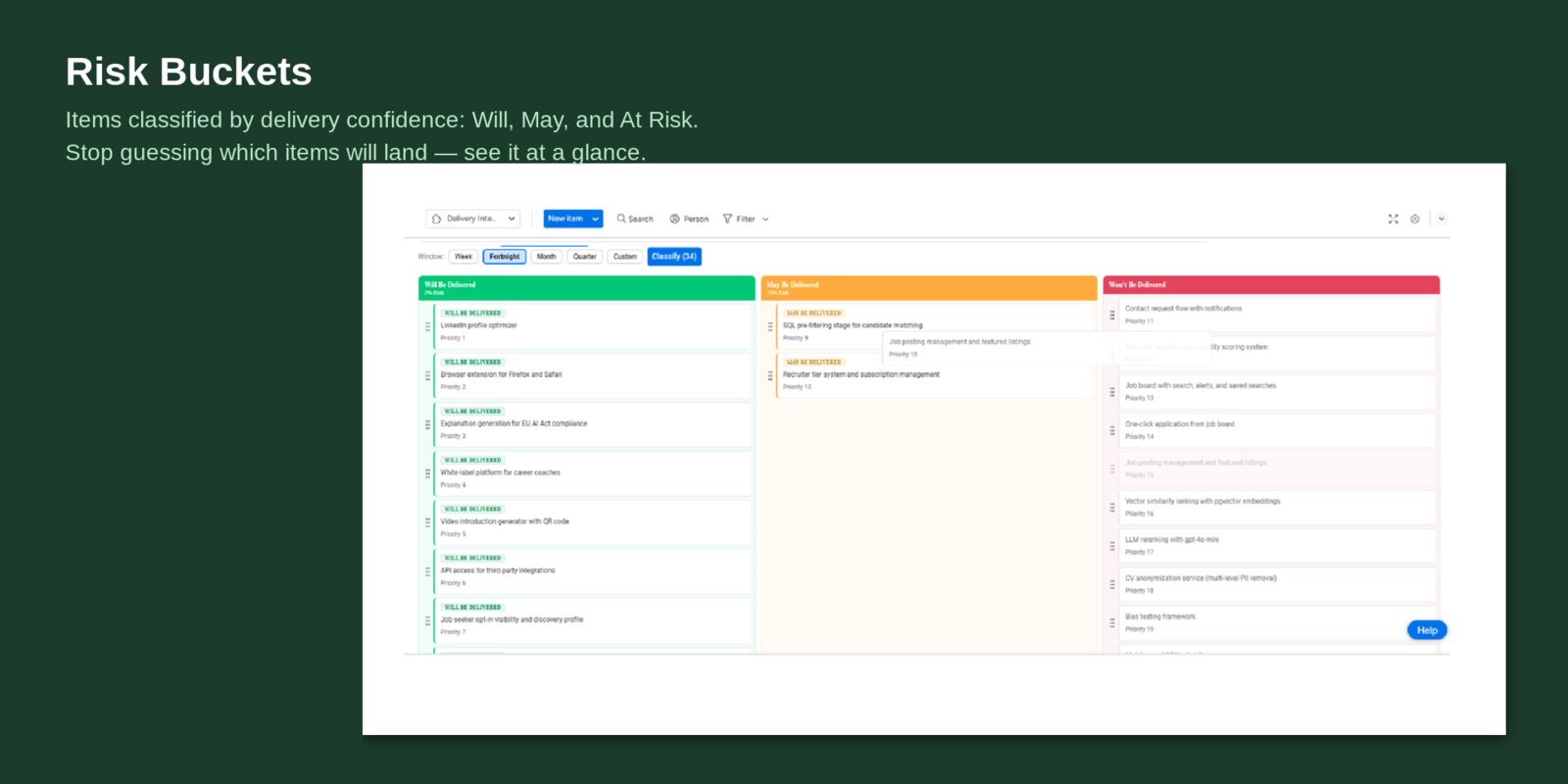
Items classified by delivery confidence into Will, May, and At Risk — with drag-and-drop reprioritisation that writes straight back to your board. Stop guessing which items will land.
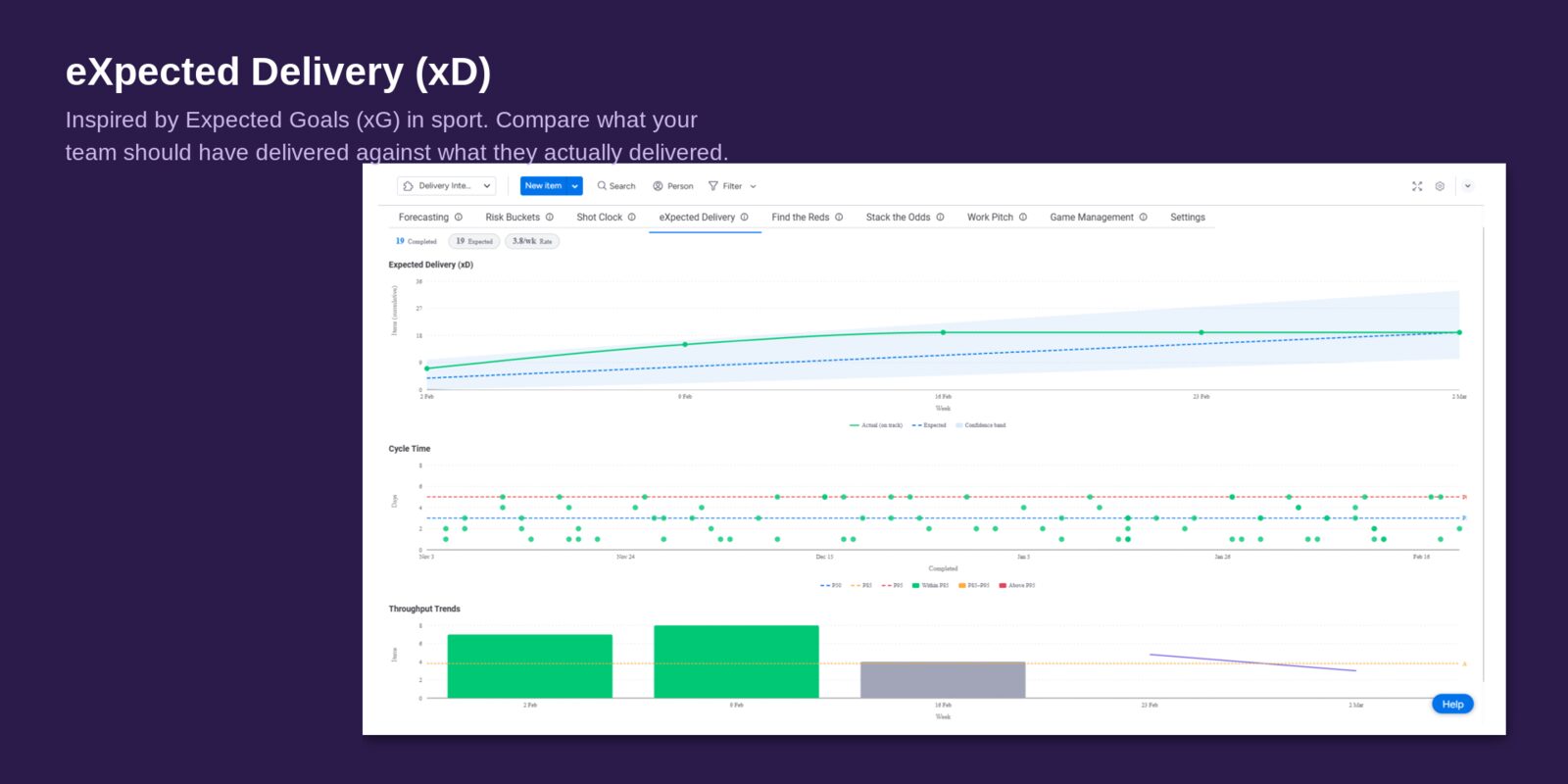
Inspired by Expected Goals (xG) in sport. Compare what your team should have delivered against what they actually delivered. Spot drift by week 2, not end of quarter.
Time-in-state tracking against your board's historical average, with coaching messages that fire before items stall — not after.
Systemic bottleneck detection. Toggle between Acute (items stalled now) and Structural (states that consistently slow everything down).
Dependency-aware delivery intelligence. See which items are blocked, blocking others, or at risk because of upstream dependencies.
Visualise your workflow as a playing field — items flow from defence through midfield to the scoring zone. Choose soccer, GAA, or generic board themes.
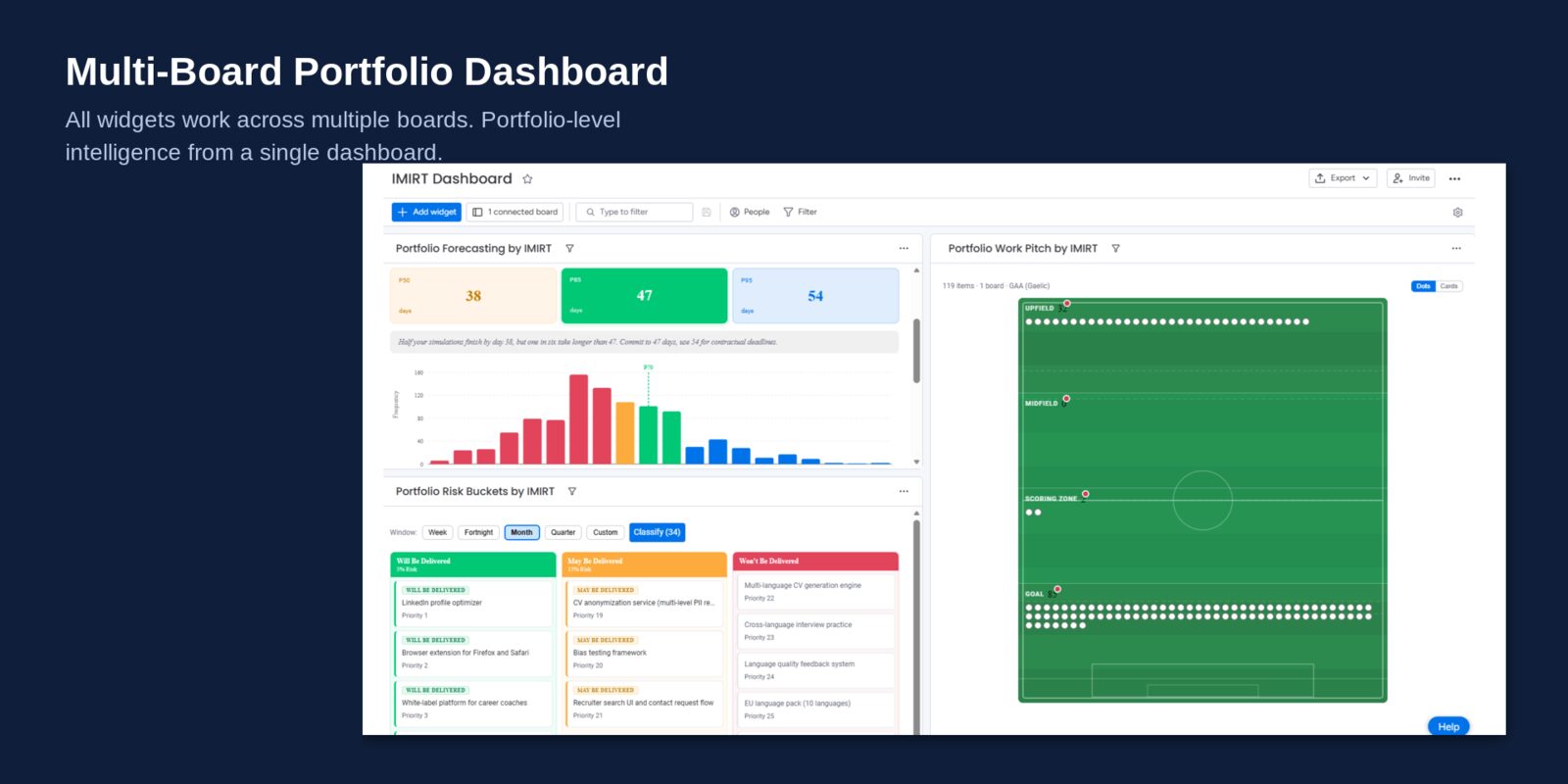
Every widget works across multiple boards. Portfolio-level delivery intelligence from a single dashboard.
An AI coaching report aggregated across boards — health scores, coaching dimensions, and actionable recommendations.
Inside the app
Pricing
Free
$0
2 boards · all features
Pro
$25/mo$49
$20/mo billed annually · price locked for 12 months · 10 boards
Launch pricing shown — a limited-time introductory rate that locks in for 12 months. Full price is $49/mo. Current pricing is always confirmed on the monday.com marketplace listing.

FAQ
Yes. Delivery Intelligence by IMIRT is the first probabilistic forecasting app on the monday.com marketplace. It runs Monte Carlo simulation on your board's real completion history to answer How long? When? How much? and How likely? — with P50, P85 and P95 confidence levels.
Monte Carlo forecasting runs thousands of simulated futures from your team's actual throughput, producing a range of outcomes with probabilities instead of a single guessed date. IMIRT runs 1,000 simulations on your monday.com board history and reports P50/P85/P95 confidence bands.
Only the boards where you've added the app as a board view. We access item names, statuses, activity logs (status change history), and board structure.
Forecasts are based on your team's actual completion history using Monte Carlo simulation — the same technique used in financial modelling and engineering. Accuracy improves with more history: 8+ weeks of data gives reliable results; 12+ weeks is ideal.
Yes, as long as your board has a status column. The zone mapping wizard lets you map any set of statuses to the five workflow zones.
The app will still work, but forecasts will have wider confidence bands. The data quality badge shows you how much history is available.
Yes. Add the board view to each board individually, and use dashboard widgets to aggregate data across boards for portfolio-level views.
Not immediately. Forecasts are based on historical throughput. New team members need ramp-up time before their contributions appear in the data.
Forecasting calculations are stateless and performed on our secure servers. Results are returned in real time. Your board data is statelessly passed to our system per forecast calculation and is not persisted by us outside of monday.com.
More questions? The full documentation is at tuesday.whatifwe.ai/docs.
Run the plays
The five plays give teams the ability to see reality early — the same behavioural spine the software measures in real time. Free PDF, sent personally.