Play 1
Find the RedsBehaviour Before Outcome
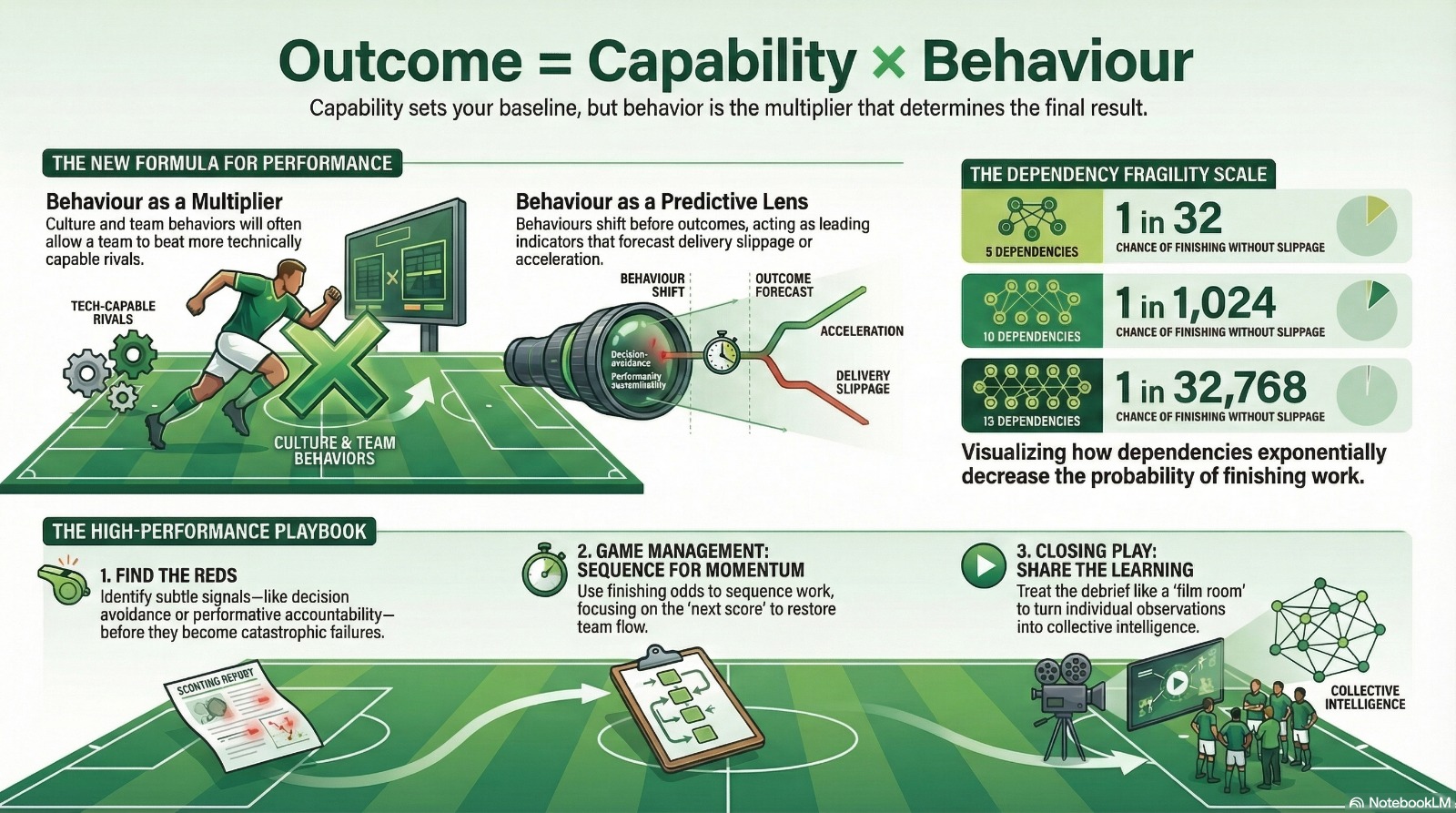
Every improvement begins with seeing reality. Reds are the earliest microbehaviours that predict delivery drift — long before any dashboard catches up.
The Problem
Every team broadcasts its trajectory long before performance shifts. The signals are always there — subtle, behavioural, and easy to rationalise away. In sport, analysts are trained to see them instantly: a defender checking out of a play, a midfielder hesitating on a pass. These aren't errors. They're indicators. Work is no different. The game is just less visible.
Symptoms include
- OKRs with no evidence of measurement
- Strategy that exists but isn't understood
- Everything becoming priority number one
- Back-channels emerging to get work done
- Heroes carrying the system
- Decisions being avoided that were once made with ease
- Meetings where challenge disappears
- Individuals quietly disengaging
- Work becoming harder to explain than to complete
Why this play matters
Reds are the warning, not the problem. By the time metrics move, the behaviours that caused the movement have been present for weeks or months. Reds are the earliest indicators of delivery risk, loss of focus, cultural drift, leadership misalignment, decision paralysis, and erosion of psychological safety. A team that can see these signals early can correct course early. A team that can't will drift until the outcomes force a conversation.
Sports analogy
Microbehaviours Reveal Trajectory
On a pitch, you see the truth instantly — hesitation, drift, loss of intensity, avoidance of challenge. These microbehaviours appear long before the scoreboard shifts. They are the earliest signals of trajectory.
Years of analysing GAA matches in Mayobridge made this unavoidable. Culture wasn't a slogan — it was a lived identity. Behaviour was the earliest, most reliable indicator of performance. Working with athletes like Charlie Smyth only reinforced it: his rise wasn't driven by talent alone, but by microbehaviours — focus cues, discipline under pressure, the ability to block out noise.
The same patterns appear in enterprise teams. Leaders feel drift before they can articulate it. Delivery slips quietly. Confidence erodes silently. The behaviours always move first.
Business application
How to run it in delivery
You don't find reds in dashboards. You find them in behaviour. Look for changes in Language (how people talk about the work), Energy (where attention goes, and where it doesn't), Consistency (whether actions match stated priorities), Momentum (whether the team is accelerating or stalling), and Engagement (who is leaning in and who is stepping back).
Reds are rarely hidden. They are simply unacknowledged.
The goal is not to eliminate reds. The goal is to surface them early enough that the cost of change is still low. Reds lose their power the moment they become discussable.
Guided exercise
What to Do When You Find a Red
When you spot a red, start by naming it — neutrally, without blame. The rest of the play walks you through describing the behaviour (not the person), connecting it to impact (what it predicts, not what it proves), inviting perspective from the team, and deciding the smallest next step — not a fix, a movement.
The remaining 4 steps of What to Do When You Find a Red live in the full playbook — along with the templates, examples, and the follow-up behaviours that make the play stick.
Tease and gate
Get the complete Find the Reds play with all 5 guided steps.
Expected outcomes
Teams that run this play report
- Earlier identification of delivery risk
- More focused conversations in real time
- Improved psychological safety around uncertainty
- Stronger alignment between delivery and leadership
- Intervention points while change is still cheap
"Reds are not dramatic failures. They are microbehaviours that reveal a shift in mindset, clarity, or confidence." — from Andrew Locatelli Woodcock's draft, captured verbatim in the Playbook.
FAQ
Common questions
- What are "reds" in the IMIRT Playbook?
- Reds are microbehaviours that reveal a shift in mindset, clarity, or confidence before outcomes change. They show up in language, energy, consistency, momentum, and engagement — not in dashboards. Finding them early gives leaders intervention points while change is still cheap.
- Why is Find the Reds the first play?
- Every other IMIRT play depends on the ability to see reality early. Focus, perspective, sequencing, momentum — all of them rely on the team's ability to recognise behavioural drift before it becomes performance drift. Finding the reds is not a skill. It's a habit. A way of paying attention. A way of reading the field.
- How do I surface a red without blaming someone?
- Describe the behaviour, not the person. Connect it to impact — what it predicts, not what it proves. Invite perspective from the team and agree the smallest next step. Reds lose their power the moment they become discussable, and discussable means neutral language.
- What's the difference between a red and a bad metric?
- A bad metric is a lagging indicator — the outcome has already shifted. A red is a leading indicator — a behaviour that predicts the shift is coming. Reds appear weeks or months before metrics move, which is exactly why they matter.
Problems this play solves
Run the plays
Run Find the Reds with the full IMIRT Playbook.
Five plays, five guided exercises, one free PDF.