Play 3
Fresh PerspectivesBreak Perspective Blindness
Teams rarely struggle because they lack capability. They struggle because they lose perspective. The Work Pitch makes the game visible again.
The Problem
Teams rarely struggle because they lack capability. They struggle because they lose perspective. When you're deep inside the work, you stop seeing what the work actually looks like. Complexity becomes normal. Assumptions harden. Drift becomes invisible. This is perspective blindness — and it's one of the most reliable predictors of delivery risk.
Symptoms include
- Starting work because it feels urgent, not because it's ready
- Pushing items forward instead of strengthening them
- Carrying too many items in the scoring zone
- Ignoring upstream decisions that will inevitably block progress
- Treating motion as momentum
- Assuming "we'll sort it out later"
Why this play matters
In sport, this is obvious. A coach on the sideline sees patterns a player on the pitch can't. A video analyst sees spacing, timing, and movement that disappear in real time. A teammate on the bench spots risks and opportunities no one in the heat of play can detect. Work behaves the same way. The problem is that most teams never make the work visible enough for anyone to see it clearly. Fresh perspectives cut through that blindness.
Sports analogy
The Coach, The Analyst, The Bench
The coach on the sideline sees patterns a player on the pitch can't. The video analyst sees spacing, timing, and movement that disappear in real time. A teammate on the bench spots risks and opportunities no one in the heat of play can detect.
This is the organisational equivalent of a kids' football match where everyone chases the ball at once. Chaos feels like effort, but it destroys finishing odds.
When teams visualise their work as a pitch, they see truths that were previously invisible: overcrowding in the scoring zone, dependencies stretching all the way back to backlog, items that look close to done but are structurally fragile, upstream decisions that are still unstable, work that is being pushed instead of prepared.
Business application
How to run it in delivery
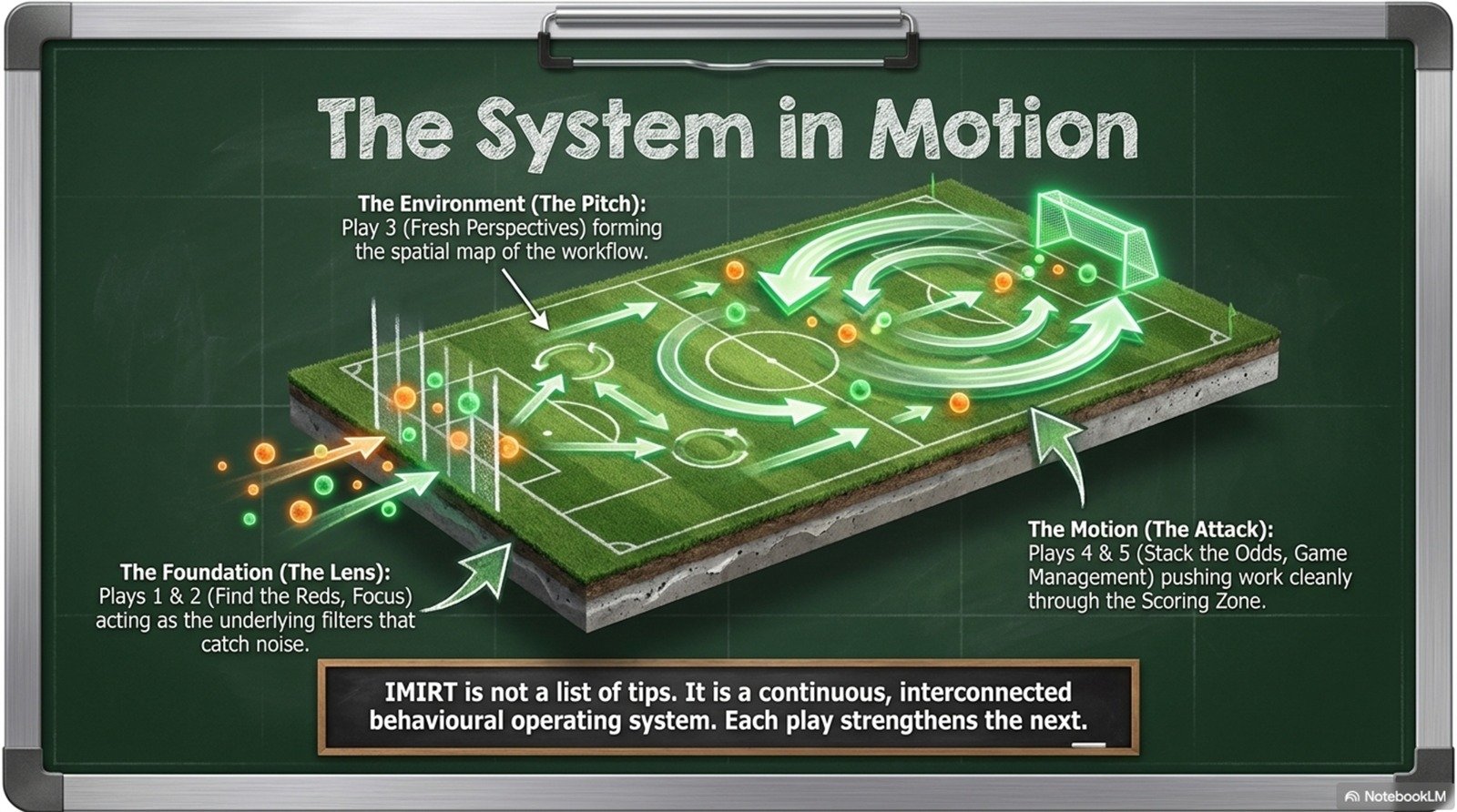
The Work Pitch reframes delivery as a field of play with three zones: Upstream — where ideas form, decisions stabilise, and dependencies gather. Midfield — where work is shaped, clarified, and strengthened. Scoring Zone — where finishing happens, and where fragility is most exposed.
Once the work is mapped onto this pitch, patterns appear instantly: what's genuinely in play right now? What's stuck upstream? What's crowding the scoring zone? Where are dependencies creating hidden risk? What looks "nearly done" but is mathematically unlikely to finish?
In one analysis, over 60% of work items were sitting in the scoring zone — many with dependencies that made finishing almost impossible. The team believed they were close to delivery. The Work Pitch showed they were close to collapse. Perspective changes everything.
Fresh perspectives shift teams from chasing starts to sequencing smarter finishes, from pushing work forward to strengthening it before it moves, from assuming readiness to making readiness visible, and from reacting to urgency to seeing the real game state. The Work Pitch isn't a reporting tool. It's a behavioural intervention.
Guided exercise
Map Your Work Pitch
Start by visualising your workflow as a pitch — upstream, midfield, scoring zone. Place current work items across it. The rest of the exercise walks you through spotting overcrowding (especially in the scoring zone), tracing dependencies back upstream to expose potential blockers, and discussing sequencing: what needs to move, what needs to wait, what needs strengthening.
The remaining 4 steps of Map Your Work Pitch live in the full playbook — along with the templates, examples, and the follow-up behaviours that make the play stick.
Tease and gate
Get the complete Fresh Perspectives play with all 5 guided steps.
Expected outcomes
Teams that run this play report
- Clearer visibility of what's truly in play
- Better prioritisation and sequencing
- Earlier detection of delivery risk
- Stronger alignment across roles
- Faster, cleaner decision-making
In one analysis, over 60% of work items were sitting in the scoring zone — many with dependencies that made finishing almost impossible. The team believed they were close to delivery. The Work Pitch showed they were close to collapse.
FAQ
Common questions
- What is the Work Pitch?
- A visualisation that treats delivery as a field of play with three zones — Upstream, Midfield, and the Scoring Zone. It replaces fragmented Jira boards, spreadsheets, and Slack threads with one shared mental model of where work actually is, and what state it's really in.
- What is "perspective blindness"?
- The pattern where teams immersed in delivery stop seeing what the work actually looks like. Complexity becomes normal. Assumptions harden. Drift becomes invisible. Perspective blindness is one of the most reliable predictors of delivery risk — and it's exactly what Fresh Perspectives is designed to break.
- How is the Work Pitch different from a Kanban board?
- A Kanban board shows status. The Work Pitch shows position and readiness. It surfaces where items are fragile, where dependencies gather, and where the scoring zone is being flooded — not just which column each card lives in.
- What behavioural shifts does it produce?
- Four shifts: chasing starts → sequencing smarter finishes; pushing work forward → strengthening it before it moves; assuming readiness → making readiness visible; reacting to urgency → seeing the real game state.
Run the plays
Run Fresh Perspectives with the full IMIRT Playbook.
Five plays, five guided exercises, one free PDF.