Play 4
Stack the OddsSee Work Through Probability
Teams don't fail at starting — they fail at finishing. The fragility is baked in long before work reaches the scoring zone. Stack the Odds makes it visible.
The Problem
Teams don't struggle because they lack capability. They struggle because they unknowingly stack the odds against themselves — not at the point of delivery, but at the point of design. The fragility is baked in long before the work reaches the scoring zone. In sport, finishing odds are instinctive: a forward taking a shot from ten metres, unmarked, with a clear line of sight has high odds. Add a defender, reduce the angle, increase the distance, apply pressure — the odds collapse. Players adjust their decisions based on probability, not hope. Work behaves the same way. The difference is that most teams never calculate the odds.
Symptoms include
- Treating all work as equal, regardless of fragility
- Assuming everything can be finished if the team "works hard enough"
- Starting work without understanding dependencies, risks, or constraints
- Carrying items with 10–20 dependencies without realising it's a bet against yourself
- No visibility into the probability of finishing
Why this play matters
Every work item has a probability of finishing. Most teams never look at it. Finishing odds are shaped by the number of dependencies, the clarity of the problem, the stability of the decision, the availability of the people involved, and the presence of blockers or constraints. When these factors are ignored, teams create work that is mathematically unlikely to finish — no matter how hard they push. This isn't a capability issue. It's a visibility issue.
Sports analogy
Create High-Probability Shots
High-performing teams in sport don't chase low-percentage shots. They create high-percentage ones. They move the ball, adjust the shape, and create conditions where finishing becomes likely.
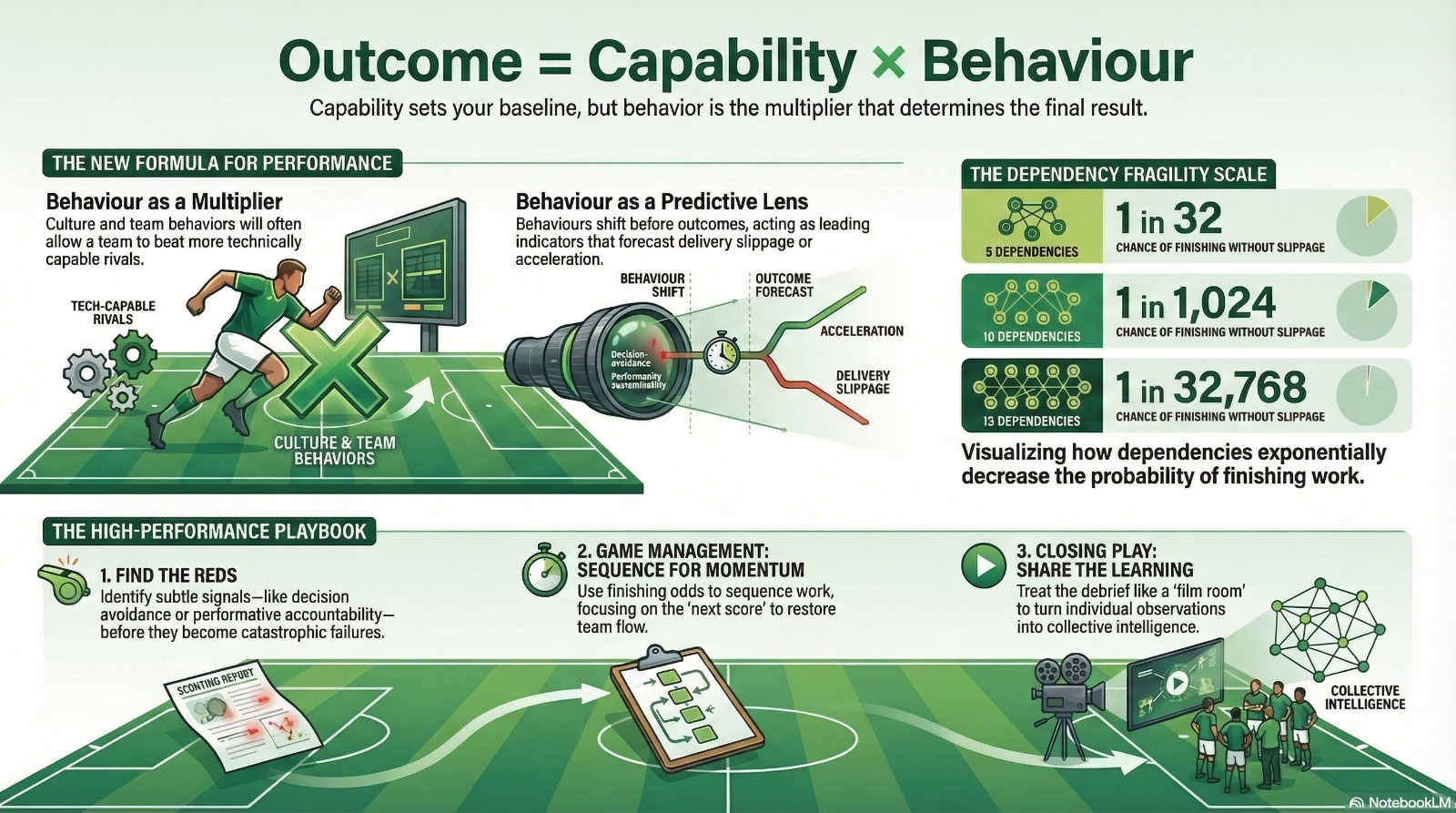
Dependencies are the biggest driver of finishing odds — each one doubles the chance of delay. A work item with 5 dependencies has a 1-in-32 chance of finishing without slippage. 10 dependencies is 1-in-1,024. 15 dependencies is 1-in-32,768.
Work is no different. Teams must create conditions where finishing becomes the natural outcome, not the heroic one.
Business application
How to run it in delivery
Stack the Odds changes the conversation. Instead of "Can we get this done?", "Do we have capacity?", and "Let's start and see how far we get," teams begin asking: "What are the finishing odds on this item?" "What is making this fragile?" "How do we improve the odds so this becomes finishable?" This is the shift from hope to evidence. From optimism to likelihood. From activity to probability.
When a team identifies an item with long finishing odds, the goal isn't to push harder — it's to strengthen the work. The five most effective behaviours: (1) Resize the work — break it into smaller, independent pieces with fewer dependencies. (2) Remove or reduce dependencies — challenge whether each is real, necessary, or avoidable. (3) Clarify the problem — ambiguity is a hidden dependency. (4) Stabilise the decision — unmade or unstable decisions destroy finishing odds. (5) Simplify the path — remove steps that add complexity without adding value.
Improving finishing odds isn't about doing less work. It's about making the work finishable. Once a team understands the odds, the next behavioural shift becomes obvious: sequence the work to maximise finishing.
Guided exercise
Calculate Your Odds
Select all your current work items in play. For each item, count the number of dependent children, and use 2^n (where n is the number of dependencies) to estimate the probability of finishing without delay. The rest of the exercise walks you through diagnosing whether the current sequencing stacks the odds for or against the team — and which of the five strengthening moves to run on each fragile item.
The remaining 4 steps of Calculate Your Odds live in the full playbook — along with the templates, examples, and the follow-up behaviours that make the play stick.
Tease and gate
Get the complete Stack the Odds play with all 5 guided steps.
Expected outcomes
Teams that run this play report
- Fewer surprises
- Fewer items stuck in the scoring zone
- Clearer sequencing
- Stronger decision-making
- Higher delivery confidence
- More predictable outcomes
FAQ
Common questions
- How exactly does 2^n work?
- n is the number of dependencies an item carries. 2^n approximates the odds of finishing without delay, assuming each dependency has an even chance of slipping independently. Five dependencies is about 1-in-32. Ten is 1-in-1,024. Fifteen is 1-in-32,768. The maths is unforgiving.
- What's the difference between capacity and finishing odds?
- Capacity is how much you could start. Finishing odds are how likely you are to actually finish. Teams optimise for capacity and then wonder why rollover keeps happening. Stack the Odds shifts the conversation from "Can we do it?" to "What are the odds?"
- How do I improve finishing odds without reducing scope?
- Five moves: resize the work into smaller independent pieces, remove or reduce dependencies, clarify the problem (ambiguity is a hidden dependency), stabilise the decision, and simplify the path. You're not doing less — you're making the work finishable.
- Is this the same as reducing WIP?
- Reducing WIP helps, but Stack the Odds goes further. Two teams with the same WIP can have wildly different finishing odds depending on how dependencies are sequenced and how stable the decisions are. The play is about strengthening the work, not just doing less of it.
Problems this play solves
Run the plays
Run Stack the Odds with the full IMIRT Playbook.
Five plays, five guided exercises, one free PDF.